Skip to content
  • Home
  • Subscribe / donate
  • Events calendar
  • News
    • Local
    • National
    • Israel
    • World
    • עניין בחדשות
      A roundup of news in Canada and further afield, in Hebrew.
  • Opinion
    • From the JI
    • Op-Ed
  • Arts & Culture
    • Performing Arts
    • Music
    • Books
    • Visual Arts
    • TV & Film
  • Life
    • Celebrating the Holidays
    • Travel
    • The Daily Snooze
      Cartoons by Jacob Samuel
    • Mystery Photo
      Help the JI and JMABC fill in the gaps in our archives.
  • Community Links
    • Organizations, Etc.
    • Other News Sources & Blogs
    • Business Directory
  • FAQ
  • JI Chai Celebration
  • JI@88! video

Recent Posts

  • Eby touts government record
  • Keep lighting candles
  • Facing a complex situation
  • Unique interview show a hit
  • See Annie at Gateway
  • Explorations of light
  • Help with the legal aspects
  • Stories create impact
  • Different faiths gather
  • Advocating for girls’ rights
  • An oral song tradition
  • Genealogy tools and tips
  • Jew-hatred is centuries old
  • Aiding medical research
  • Connecting Jews to Judaism
  • Beacon of light in heart of city
  • Drag & Dreidel: A Queer Jewish Hanukkah Celebration
  • An emotional reunion
  • Post-tumble, lights still shine
  • Visit to cradle of Ashkenaz
  • Unique, memorable travels
  • Family memoir a work of art
  • A little holiday romance
  • The Maccabees, old and new
  • My Hanukkah miracle
  • After the rededication … a Hanukkah cartoon
  • Improving the holiday table
  • Vive la différence!
  • Fresh, healthy comfort foods
  • From the archives … Hanukkah
  • תגובתי לכתבה על ישראלים שרצו להגר לקנדה ולא קיבלו אותם עם שטיח אדום
  • Lessons in Mamdani’s win
  • West Van Story at the York
  • Words hold much power
  • Plenty of hopefulness
  • Lessons from past for today

Archives

Follow @JewishIndie
image - The CJN - Visit Us Banner - 300x600 - 101625

Tag: Passover

Update from the Okanagan

Update from the Okanagan

Left to right: Evan Orloff, Melina Moore, Barb Pullan lighting the candles, Rebecca Morlang and Hilla Shlomi. (photo by Roger Tepper)

The Okanagan Jewish Community has been busy over the last couple of months. They are also gearing up for their annual golf tournament, which takes place in July.

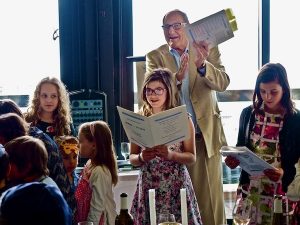
On April 22, the OJC hosted a Passover seder at Summerhill Winery. Led by Allan Holender, approximately 150 people attended, including 30 kids under 12. Dr. Jessica Strasberg organized the children’s crafts and activities, Ronit Little made the charoset for all the tables and Steven Finkleman helped with many of the food preparations and putting together the 18 seder plates; David Spevakow and Barb Druxerman volunteered a great deal of their time on preparations and planning. Steven Cipes and his family, of Summerhill Winery, hosted the event.

photo - Writer and consultant Allan Holender leads the Passover seder with some young help
Writer and consultant Allan Holender leads the Passover seder with some young help. (photo from Okanagan Jewish Community)

Also in April, Cantor Russell Jayne from Beth Tzedec in Calgary came to the Okanagan to lead services. On May 7, with special guests from the International Christian Embassy Jerusalem (ICEJ) in attendance, OJC member Evan Orloff led the services, after which there was a dairy potluck. A new rabbi has been contracted for the High Holidays this year and the OJC is looking forward to having Rabbi Lawrence Seidman and his wife Linda – who is also a rabbi – join them.

On May 15, Orloff and fellow OJC members Ed Aizen, Max and Peggy Mandelbaum, Barb Pullan, Hilla Shlomi and Seymour Zidle attended a Holocaust remembrance service held at the Lakers Clubhouse in Vernon hosted by the ICEJ. The event was put on because members of the ICEJ were greatly disturbed by the rising amount of antisemitism in the world. The ceremony included speeches, candlelighting and the presentation of a copy of the names on Schindler’s list encased in a replica suitcase which was accepted by Orloff on behalf of the OJC. Orloff is a retired teacher in Kelowna; he dedicated much of his career to educating students about the Holocaust and why it is imperative to remember. Melina Moore performed the theme song from Schindler’s List and sang Hatikvah. The service honored the lives of those who died in the Holocaust and the resilience and courage of survivors, as well as saying “never again” and “no” to antisemitism and prejudice in all its forms. The OJC is very grateful to the ICEJ, led by members Gail Mobbs and Daniel Morlang, for putting on such a touching ceremony.

During this past month, the OJC has had seven groups of students, ranging from 30 to 50 students per group from four middle and secondary schools in the area, participate in its Talks & Tours, hosted by OJC members Finkleman and Orloff. The students heard a presentation on Judaism and then enjoyed challah and grape juice with an explanation of the significance. Some of the schools attend the seminars annually, finding the presentations educational and interesting.

Last but not least, the 19th annual OJC Golf Tournament is being held on July 21. The money generated from the tournament each year enables the OJC to continue bringing in guest rabbis and cantors and to provide programming for the community; this year, part of the proceeds will also help Canadian Blood Services, a charity chosen in honor of the late Sid Segal. There is still room available for more golfers (and hole sponsors) so, if you are interested in participating in this day of golf, food, drinks and social interaction, visit ojcc.ca or contact Anne Zazuliak at the OJC office, 250-862-2305 or [email protected].

Format ImagePosted on June 3, 2016June 1, 2016Author Okanagan Jewish CommunityCategories LocalTags community, golf, Holocaust, Kelowna, OJC, Okanagan, Passover
Making Pesach matzah

Making Pesach matzah

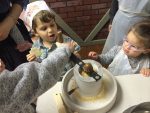
Ben Harrington churns the wheat while Joel Harrington and Sara Basya Mochkin look on. (photo from Chabad of East Vancouver)

On April 10, Chabad of East Vancouver hosted a packed Model Matzah Bakery at its Centre for Jewish Life on Fraser Street. Following a week of similar events at Chabad Lubavitch, children had an opportunity to make their own matzah from scratch. They began by winnowing the wheat kernels, then grinding and sifting them into fine flour. Water was then added to make dough. The kids rolled out the matzah, scoring it with dockers before handing it over to the grownups for baking.

The children managed to get the dough kneaded, shaped and into the oven in under 18 minutes to prevent the dough from rising. This would have made it chametz, a fermented grain, which is forbidden over Passover.

This process only began after a careful eye was cast over all of the ingredients and tools, from start to finish: whether keeping the grains and flour completely dry, to the meticulous cleaning of the tools used in the matzah production.

When 18 minutes were up, an egg timer went off, to cheers from the kids and applause from Rabbi Mendy Mochkin of Chabad North Shore.

The finished matzot were pulled from the oven by Rabbi Schneur Wineberg of Chabad East Van. After savoring the matzah with cries of “Mmm, delicious!” oranges were served, followed by knishes from Shuk restaurant.

Extra hands-on supervision was provided by Maggie Karpilovsky and the staff of North Shore Hebrew School.

Shula Klinger is an author, illustrator and journalist living in North Vancouver.

Format ImagePosted on April 22, 2016April 20, 2016Author Shula KlingerCategories Celebrating the HolidaysTags Chabad, matzah, Passover
Refugee policy evolves

Refugee policy evolves

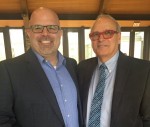
Rabbi Dan Moskovitz, left, and Dr. Harold Troper. (photo by David Berson)

The current refugee crisis – and Canada’s responses to past crises – was the topic of an interfaith panel recently, which raised issues especially relevant as Passover approaches.

Our Home and Native Land? A Multi-Faith Symposium on Refugee Settlement featured a keynote presentation by Dr. Harold Troper, co-author of None is Too Many: Canada and the Jews of Europe, 1933-1948. The event, on March 18, also included a panel discussion that featured Rabbi Dan Moskovitz of Temple Sholom. Catalina Parra brought a First Nations perspective, Imam Balal Khokhar spoke from a Muslim point of view and Rev. Dr. Richard Topping spoke as a Christian.

Troper recalled being part of a Canadian group that traveled to eastern Germany two decades ago, after the Berlin Wall fell. States in the east of the newly reunified Germany were seeing an upsurge in migration from countries further to the east. A group of Canadians was invited to listen and give advice on Canada’s experience integrating newcomers. At one point, a local official thanked Troper for his comments, but asked, “What do you do with your foreigners?”

Troper expounded on the concept of “new Canadians,” a formulation perhaps unknown in any other country, in which people arriving with the intent of making Canada their home are acknowledged not as foreigners or as migrants, but as people becoming part of our polyglot population already on a path to inclusion.

Of course, Troper acknowledged, this was not always so. None is Too Many, published in 1983, was a seminal book that has had lasting impacts on Canadian views of migration and refugees. The title comes from a quote from an anonymous Canadian immigration official who responded with these words to the question of how many post-Holocaust refugees to admit. The words have been attributed, in some tellings, to F.C. Blair, Canada’s then-director of immigration. However, while this is not provable, Blair’s actions were in line with the words.

Recounting this country’s exclusionary policies toward the desperate Jewish populations of Europe in the prewar period, but also a similar disregard after the war, the book has been held up as an object lesson in how not to respond to people in crisis. Troper said he didn’t know until years later the impact the book had had on one very significant episode in Canadian history.

In 1979, Troper and Abella sent an academic paper that preceded the book to Ron Atkey, Canada’s immigration minister. Atkey was a member of Joe Clark’s cabinet and, though that Progressive Conservative government lasted only nine months, it was during Clark’s term as prime minister that the decision was made to welcome 60,000 Vietnamese refugees, known as “boat people.” Troper said he found out later that the manuscript they sent played a role in the decision.

“We hope Canada will not be found wanting in this refugee crisis the way it was in the previous one,” the authors wrote in a note accompanying the manuscript. They expected no response and they received none. But, several years later, Troper said, Atkey told him that he had read it.

“He told us he was shocked and dismayed when he saw the political parallels between the Vietnamese and Jewish refugee crises,” Troper recalled. “Then and there, Atkey told us, he decided he was not going to go down as the F.C. Blair of the boat people.”

Already predisposed to encourage his cabinet colleagues to take a generous approach, the article stiffened his resolve to stand firm against ministers who disagreed. The government initiated a joint federal-private sponsorship program.

“It today serves as the prototype for Canada’s Syrian refugee program,” said Troper.

Now, as refugees are coming from North Africa, Asia and, most notably, the Middle East, fleeing civil war and ruin in Syria and Iraq, Troper sees parallels between the fears expressed now and those of seven decades ago.

“The fears are not only around the expenses of accommodating these refugees, but that the intake of a population of different race, religion and cultural assumptions and social expectations will destabilize destination countries,” he said.

Not dissimilar, he said, were fears that European Jews might bring socialism, communism, anarchism – even Nazism – with them.

“Foreshadowing the kind of anti-refugee arguments commonly heard today,” Troper said, “reports of persecution were dismissed as exaggerated if not bogus, fabrications designed to justify an end-run around Canadian immigration restrictions. And who were these refugees anyway? Were they really innocent victims? Surely they must have done something to turn their fellow citizens against them. Why make Europe’s problem our problem? And weren’t Jews in Canada already a pesky problem? Do we want more? And who’s to say that communists or even Nazis would not pose as refugees to infiltrate as subversives into Canada? Keeping Canada strong and united meant keeping Jews out.”

Another haunting parallel was the galvanizing photo of the 3-year-old Kurdish child who washed up on a Turkish beach and a photo Troper came across decades ago in his research for None is Too Many while going through archival boxes in the Toronto office of the Jewish Immigrant Aid Society. The boxes were filled with prewar letters from European Jewish parents who, knowing that entire families were unlikely to be granted admission to Canada, begged that their children might be taken in by a Canadian family. In each case, a terse response told the desperate parents that Canada was not admitting any Jews but that the request would be held on file in case something changed.

“Going through these files, I came across a letter that impacted me the way I imagine the photo of 3-year-old Alan Kurdi lying facedown in the sand of a Turkish beach impacted on all of us,” he said. “The letter was from a father begging for some shelter for his two daughters. A picture of two smiling children was attached. As I read this letter, my eyes began to tear; you see, I am also the father of two girls. At the time they were 3 and 5 years old. For a split moment, it was as if I was that desperate father, his children were my children and his fears were my fears.”

As part of the panel that followed, Moskovitz spoke of the bread of affliction.

“How inappropriate it might seem to hold up a matzah when we sit around a seder table filled with food, and to think that we are supposed to connect with this when we have so much,” the rabbi told the Independent after the event. “The point is to remind us that there was a time in our lives when we didn’t have so much.

“Each of the faith traditions,” he said, “spoke about that lens of empathy, of remembering historically that we once ate the bread of affliction, that we once didn’t have much and so we have to share with those who do.”

Religious perspectives are critical in this discussion, he added.

“Left to our own devices, society will often do what they think is in [their] own immediate best interest, which is often isolationism – we’re seeing that in the U.S. elections today – and fear of the other,” he said. “The role of religion is to compel us to do what is morally right and good, what is spiritually elevated, what is holy. It’s a religious foundation that is compelling us to love the stranger, because our political reality, especially in the wake of the terrorist attack in Brussels, is telling us to fear the stranger.”

For Jews, he said, the plight of refugees is not a momentary news story.

“This is not just a headline that has come and gone,” said Moskovitz. “Our Passover Haggadah makes it a headline for Jews every year, that we are reminded to see the world through the lens of a refugee every single year. It’s the most observed Jewish holiday in the Jewish calendar – that says something about how important the status of a refugee is in Jewish tradition.”

The multi-faith symposium was organized by the Inter-Religious Studies program at Vancouver School of Theology and facilitated by Rabbi Laura Duhan Kaplan, the program’s director.

Format ImagePosted on April 15, 2016April 13, 2016Author Pat JohnsonCategories LocalTags Atkey, Haggadah, Holocaust, inter-religious studies, interfaith, Passover, refugees, Syria, Troper, Vietnam, VST

Reflections on Pesach

Passover is coming next week, yet it seems to have been with us in spirit a great deal this year. Many Jewish individuals and congregations in Vancouver and elsewhere have been involved in welcoming Syrian and Iraqi refugees fleeing tyranny and violence. And, almost inevitably, part of the justification for helping has been the Exodus story.

Through our religious teachings and rituals, we are engaged in applying the experiences of the past to the events of the present. The Pesach story is certainly applicable when a people is in need of refuge. So is the more recent, and less triumphal, story of the Jewish experience in the 20th century, which saw every nation on earth shut its doors to desperate refugees until it was too late. (See “Refugee policy evolves.”)

As we join together at seder tables around the city and around the world, let us continue to invite the lessons of the past to illuminate our path to the future.

At moments during the holidays, we are encouraged to seek out the transcendent values in our traditions and integrate them into our lives so that we can make a better world. It is clear from the work being done to aid refugees that these values are already well entrenched in so many individuals and congregations. Let this Passover be a time of rededication for all of us to the values that welcome the stranger, show gratitude, celebrate freedom and hasten the world we seek.

Posted on April 15, 2016April 16, 2016Author The Editorial BoardCategories From the JITags Passover, refugees, seder
Make a butterfly for spring

Make a butterfly for spring

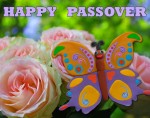
Spring is the time of nature’s reawakening, when we are treated to so many vibrant and beautiful colors and shades. Spring is also when Jewish communities around the world celebrate the unique and important holiday of Passover. So why don’t we combine the two and make a festive Passover postcard with a spring butterfly against flowery background?

In making our postcard, we can unleash our imaginations! There are so many beautiful butterflies in the world – it is impossible to count them all. And there are no strict rules in art projects, so feel free to be creative, dear young artists. But, if you want to try and make your butterfly look like a real one, you will need to choose a design you can repeat, as both wings of a butterfly are the same in design and texture.

So, gather all the brown, black, blue, yellow, purple, green, pink and other colors of Plasticine you have at home. You will also need toothpicks. Now let’s get started!

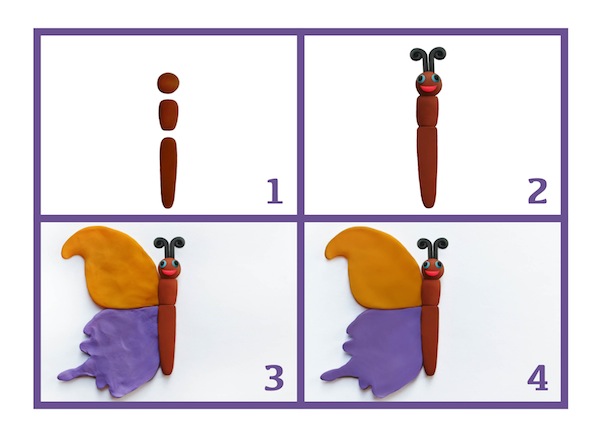
image - Passover postcard steps 1-4 by Lana Lagoonca1. Take brown Plasticine and make the butterfly’s head, thorax (torso) and abdomen.

2. Put all the butterfly body parts together. Make black antennae (a butterfly’s “whiskers”). After that, make and attach blue eyes and a pink mouth.

3. Take yellow Plasticine and make one wing, attach it to the body on the top left side. Make one more wing – purple – and attach it underneath the yellow wing.

4. Use your fingers to make the wings smooth.

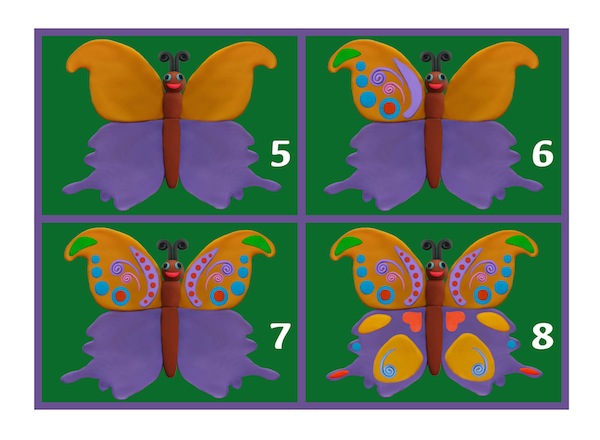
image - Passover postcard steps 5-8 by Lana Lagoonca5. Now make and attach identical wings to the right top and bottom sides. Make them smooth, too.

6. Make beautiful ornaments for the top left yellow wing using, for example, green, blue, purple, red and pink colors, just like we did. You can use other colors, if you’d like.

7. Repeat the same design on the top right yellow wing.

8. Using the same technique, make colorful ornaments for the two bottom wings on both sides. You may use yellow, orange and blue colors to do that. Now your butterfly is ready!

To make the postcard, you can put your butterfly in front of some flowers, attaching it using a piece of wire or a thin stick, and take a picture of it with this flowery background. You can then print out the image, and you will have your own beautiful Passover postcard with a fluttering butterfly.

Happy Passover, dear Jewish Independent readers – to you and your families!

Lana Lagoonca is a graphic designer, author and illustrator (lunart.ca). At curlyorli.com, there are more free lessons, along with information about Curly Orli merchandise.

Posted on April 15, 2016April 13, 2016Author Lana LagooncaCategories Celebrating the HolidaysTags butterfly, Passover, Plasticine

Life legacies in writing

“I am now face to face with dying, but I am not finished with living,” writes Oliver Sacks as the dedication to Gratitude (Knopf Canada, 2015), a collection of four essays that were written in the two years preceding his death last August.

“I have given much of my life to the Jewish world, and I wish I had many more years to serve this noble calling,” writes Edgar Bronfman in concluding his book Why Be Jewish? A Testament (Signal, 2016), which he completed mere weeks before his death in December 2013.

Bronfman continues, “But everything has its natural end, and so now, as my time on earth draws to a close, I would thank my stars even more if you would choose to stand at Sinai; if you would choose, as I did so many years ago, to join this remarkable people who generation after generation held fast to the dream that through our individual and collective efforts we could transform the troubled world we share into a more perfect, more humane, more civilized place.”

Even though he became intrigued with Judaism late in life, Bronfman still defined himself as secular, “not comfortable” calling himself an atheist “in the face of the complexity of the universe.” He had a connection to Judaism through his grandfather, but it was weak. “My parents,” he writes, “for whatever reason, failed to instil much-needed Jewish pride in their children.”

Sacks was a self-described atheist. For him, it was his mother’s strongly negative reaction to the news of his homosexuality that pushed him away from belief: “The matter was never mentioned again, but her harsh words made me hate religion’s capacity for bigotry and cruelty,” he writes.
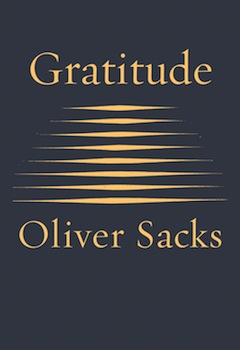
book cover - GratitudeHowever, the final essay in Sacks’ Gratitude is called “Sabbath.” In it, he recalls his parents’ observance of Shabbat, a day that “was entirely different from the rest of the week.” He recalls how the family would mark the day, how he became bar mitzvah, his break with his family and community in England after he qualified as a doctor and moved to Los Angeles, his “near-suicidal addiction to amphetamines,” his recovery and how he “became a storyteller at a time when medical narrative was almost extinct.” In addition to being a neurologist, most readers know, Sacks was an author – he wrote more than a dozen books, including Awakenings, The Man Who Mistook His Wife for a Hat and other Clinical Tales and An Anthropologist on Mars.

Sacks comes to appreciate Shabbat: “And now, weak, short of breath, my once-firm muscles melted away by cancer, I find my thoughts, increasingly, not on the supernatural or spiritual but on what is meant by living a good and worthwhile life – achieving a sense of peace within oneself. I find my thoughts drifting to the Sabbath, the day of rest, the seventh day of the week, and perhaps the seventh day of one’s life as well, when one can feel that one’s work is done, and one may, in good conscience, rest.”

Gratitude is a short but powerful collection. It is masterfully written and nearly impossible to get through without crying. All of the essays have been published before, but having them together for re-reading, rethinking and re-feeling is more than worthwhile. Every read will be a cathartic experience.

The first essay, “Mercury,” was written just before Sacks’ 80th birthday in July 2013. In it, he talks about what it feels like to be turning 80, some of his regrets, but mostly how much he has left to do, “freed from the factitious urgencies of earlier days, free to explore whatever I wish, and to bind the thoughts and feelings of a lifetime together.”

“My Own Life” is named after the autobiography of one of Sacks’ favorite philosophers, David Hume. Sacks shares a couple of paragraphs from that 1776 work, using it to lead into a discussion of his own state of mind. “My generation is on the way out, and each death I have felt as an abruption, a tearing away of part of myself.” While not without fear, he writes, “my predominant feeling is one of gratitude. I have loved and been loved; I have been given much and I have given something in return; I have read and traveled and thought and written.”

In the third of the four essays, “My Periodic Table,” Sacks talks of his love of the physical sciences and how, since “death is no longer an abstract concept, but a presence,” he is surrounding himself again, as he did when he was a boy, “with metals and minerals, little emblems of eternity.” On his writing table is a gift from friends for his 81st birthday, thallium, as well as lead, for his recently celebrated 82nd birthday. After discussing the treatment of his cancer, he expresses his skepticism about reaching 83, his bismuth birthday. He did, indeed, pass away at 82.
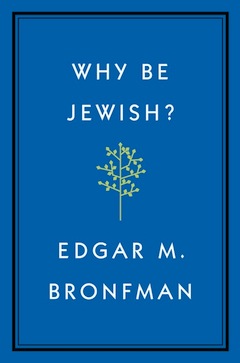
book cover - Why Be Jewish?Bronfman died at 84. It is particularly fitting to be discussing his book Why Be Jewish? as Passover nears. Two of the nine chapters are directly related to the holiday: Chapter 8 is about its rituals, the story, the symbolic aspects, its importance, while Chapter 9 presents the principles and practices of leadership as demonstrated by Moses – not Moses the manager, but rather, “Moses the man who, as flawed as he was, executed brilliant strategies that ultimately transformed much of the world. These principles are also relevant to everyday leadership, from parenting to day-to-day responsibilities at work.”

There are many lessons Bronfman derives from Moses and the Exodus story. Good leadership involves standing up for something, perseverance, vision, pragmatism, courage, celebration of accomplishment, allowing opinions (even complaints, perhaps especially complaints), awareness of one’s strengths and shortcomings, adherence to a moral code, the duty to pass the mantle. He doesn’t believe that Moses’ non-admittance into the Promised Land was a punishment – instead, from Mount Nebo, Moses is permitted to see the entire Promised Land, “God is showing Moses the future that is really what most leaders want: they want to know that their dreams and vision will live on.”

Bronfman notes about the Torah’s last word, Israel: “It seems to me that we are being told that the commitment to Israel – the people – must be the focus, not Moses. And since ‘Israel’ means wrestling with God, the Torah also seems to charge the Jewish people with the task of ‘wrestling,’ a term I take to mean a commitment to struggling with that which we find difficult to embrace and not letting go until we find the truths we seek.”

In another chapter – on the rest of the Jewish holidays – Bronfman writes that he “would like to see the institution of Yom Ha’atzmaut Circles in synagogues and communities where Jews of multiple views could come together to discuss books that put forth different ideas on Israel’s situation, from Alan Dershowitz’s The Case for Israel to David Grossman’s novel To the End of the Land.”

He also talks of Shabbat, referring to the group Reboot, “a network of young, creative Jews who have sought ways to grapple with questions of Jewish identity and community in terms that will be meaningful to their generation….” He gives examples of other youth who are engaged in a meaningful Jewish life and the book’s foreword is written by Angela Warnick Buchdahl, who was a Bronfman Fellow in Israel in 1989. The program for high school juniors was founded by Bronfman, former chief executive officer of Seagram Co. Ltd., who also was chair of the board of governors of Hillel International and president of World Jewish Congress. Bronfman has written other books, including The Bronfman Haggadah with his wife, artist Jan Aronson.

The goal of Why Be Jewish? is to encourage nonreligious Jews – especially the younger generation – to practise the elements of Judaism that speak to them, and it is written to that audience. He touches upon all the basics of Judaism from the perspective that, “Judaism does not demand belief. Instead, it asks us to practise intense behaviors whose purpose is to perfect ourselves and the world.”

Bronfman’s approach is appealing in many ways, and he offers practical advice for the non-observant on how to connect with Judaism’s tenets and traditions. Even for the somewhat-observant Jew, many of his ideas will be interesting. His outlook is positive and well conceived. It is also inclusive.

He writes, “My own feeling is that Judaism is a big family of individuals with a common bond that has stayed strong through a long history and much hardship. Those who want to become part of this story are Jews, too. I believe the tent should be open and welcoming to anyone who wishes to join.

“For younger Jews today, choosing a particular ethnicity or culture may seem too narrow a form of self-identification. But I do not see Judaism as a form of tribalism that divides rather than unites. The Jewish people are one of the many vibrant patches on the richly diverse quilt of humanity. Each patch has its own design and, together, they make a beautiful whole. Embracing your heritage deepens your understanding of who you are and where you come from and brings you into a more meaningful relationship with the multicultural world.”

Format ImagePosted on April 15, 2016April 13, 2016Author Cynthia RamsayCategories BooksTags Edgar Bronfman, Judaism, memoir, Moses, Oliver Saks, Passover
Making your Haggadah unique

Making your Haggadah unique

The website haggadot.com offers numerous template options.

The Hebrew word haggadah means narration or telling. As the Passover seder’s instruction manual, the Haggadah is perhaps the most important tool for fulfilling the Passover mitzvah of telling the story of the Jewish Exodus from Egypt – a mitzvah that is mentioned six times in the Torah.

The Rambam (Maimonides) in his Mishneh Torah explains that relating the miracles and wonders that were done for our ancestors in Egypt on Passover night is a positive commandment, and that it is a mitzvah to inform our children about it. Many interpret this to mean that telling the Passover story is actually two mitzvot: a mitzvah to tell the story among adults and a mitzvah to teach children about the story.

ArtScroll and Maxwell House have done their parts to make a simple seder manual accessible and inexpensive. But sometimes just reciting the words of the seder isn’t enough to engage seder participants – or even to help them understand the Passover story.

“What I learned is that my family had never really understood the service they had been using for many, many years,” said

Barbara Bayer of Overland Park, Kan., who about 30 years ago decided to write a Haggadah, which she continues to revise each year. “I went to simple sources that told the story simply and succinctly and the family loved it and still does.”

Making your own Haggadah is not as complicated as one might think. For starters, there are many web platforms that allow you to create a customized seder manual by providing curated sources from across the Jewish community. Haggadot.com, for instance, offers readings, artwork and video clips to enliven the seder. The clips can be assembled in one of the website’s templates.

Other sites, such as livelyseders.com, allow users to download an English translation of the complete traditional Ashkenazi Haggadah text, which can be cut and pasted to create your own piece. Jewishfreeware.org carries a range of editions of Haggadot, each one directed to specific interests and needs, in terms of the Haggadah’s length and rituals of choice. All the files are downloadable and some are editable.

Once you’ve found your base, personalizing the Haggadah for your seder experience can be loads of fun and really creative, according to those who do it.

Renee Goldfarb of Solon, Ohio, said one year she set up a laptop, projector and screen at the Passover table and showed a relevant video for each of the 15 steps of the seder.

Suzanne Levin-Lapides, on the other hand, compiled her family Haggadah from the texts of various seders for women she had attended in her Baltimore community, adding an orange to her seder plate as a symbol of feminism, as well as the inclusion of LGBT individuals and other marginalized groups within the Jewish community.

At the Katz family home in Kemp Mill, Md., the Passover seder has been turned into a play by their 12-year-old daughter, Abigail.

Read more at jns.org.

Format ImagePosted on April 15, 2016April 13, 2016Author Maayan Jaffe-Hoffman JNS.ORGCategories Celebrating the HolidaysTags Haggadah, Passover
Celebrate Shabbat, Pesach

Celebrate Shabbat, Pesach

One look, and it’s clear – it’s springtime in Vancouver. It is no accident that Passover is celebrated at this time of year. (photo from Alex Kliner)

This year, Passover begins on Friday night, April 22, and continues through Saturday, April 30. The first seder is on Shabbat and the second is on Saturday evening. What is the significance of this?

Rabbi Moshe ben Maimon (Rambam or Maimonides) was born on the eve of Passover in 1135 in Cordoba, Spain. He writes that, on the night of the 15th of Nissan, it is a positive commandment of the Torah to relate the miracles that transpired with our forefathers in Egypt. For it is written, “Remember this day on which you went out of Egypt.” The meaning of “remember” here is similar to that which is written about Shabbat: “Remember the day of Shabbat.”

The Rambam explains, at the beginning of the Laws of Shabbat, that resting from labor on the seventh day is a positive commandment, for it is written, “On the seventh day you shall rest.” The fact that the Rambam begins the laws with the positive command indicates that the main aspect of Shabbat observance lies in the positive aspect. Shabbat is a weekly occurrence, when we take a break from our work and enjoy time with family and friends at home and in synagogue, as we focus on the spiritual aspects of the day.

By connecting the tale of the Exodus on 15 Nissan to the remembrance of Shabbat, the Rambam is indicating that, with regards to relating the events of the Exodus, the main aspect is the positive step of becoming free. So, the obligation to relate the story of the Exodus involves not only the recalling of our release from slavery, but the recounting of how we became free. The Haggadah adds that an individual is obligated to feel as if they themselves had just gone out of Egypt.

As Passover approaches, the Torah instructs us that this festival of liberation should always be celebrated in the spring – Chodesh Ha’aviv, the month of spring. It relates that, on the day of Rosh Chodesh Nissan (the head of the month of Nissan), two weeks before the deliverance from Egyptian enslavement, we received the first mitzvah: sanctification of the new moon, whereby the first day of each month is sanctified as Rosh Chodesh, in conjunction with the molad (rebirth) of the moon as it reappears as a narrow crescent.

Together with this came other details of our Jewish annual calendar. Our calendar is based on the lunar year (12 lunar months), coupled with an adjustment to the solar year by the insertion of an additional month every two or three years, making a leap year, consisting of 13 months, as we just marked with the months of Adar I and Adar II. In this way, the accumulated lag of the lunar year relative to the solar year, 11.5 days, is absorbed. This requirement and the necessity for Nissan to fall in the spring, the time of the Exodus, is vitally important, so all our other Jewish festivals also occur in their proper season; for example, that Sukkot takes place in autumn.

On Rosh Chodesh Nissan, G-d instructed us, the Jewish nation, about the Passover sacrifice and the laws of the festival of Pesach, which is also known as the Festival of our Liberation. This was deliverance from our physical slavery from ancient Egypt. However, given that the instructions in the Torah are eternal and valid at all times and wherever Jews live, in every generation, the Festival of our Liberation is also freedom in a spiritual sense; that we might be liberated from our limitations and leap over our everyday shackles.

How? By focusing our energy on our being free and thanking G-d for allowing us to be able to use our minds to release ourselves from any obstacles we may face. Also, by remembering that G-d loves us so much that He Himself redeemed us, not wanting to send any angels to do this precious job for His suffering children. Due to His great love for us, He took us out in the spring, when the weather was favorable.

This Passover, in the Lower Mainland, we are fortunate to be able to see the renewal in the earth, as trees and flowers bloom and fruits blossom, the rainy weather that we have endured for months changes to sunshine and baby birds and animals are born.

May we enjoy this special Passover, which begins and ends on Shabbat, with family, friends and guests at our seders, yom tov meals and synagogue or Chabad House attendance. May G-d grant us, as the Haggadah concludes, “Next Year in Yerushalayim,” with the imminent coming of Moshiach.

Wishing everyone a special Shabbat shalom and a kosher and happy Passover!

Esther Tauby is a local educator, writer and counselor. This article is based on talks that were given by the Lubavitcher Rebbe z”l.

Format ImagePosted on April 15, 2016April 13, 2016Author Esther TaubyCategories Celebrating the HolidaysTags Judaism, Passover, Shabbat, spirituality
Sponge cake a Pesach must

Sponge cake a Pesach must

Another version of orange-glazed sponge cake, minus the Sabra. (photo from littlemisscelebration.com)

Sponge cake. It’s an integral part of Pesach for many people, even though there is no special plate for it, and no bracha said over it. Sponge cake comes in two types – angel food and true sponge.

Angel food cake has cream of tartar, an acid ingredient, which used to be combined with baking soda and salt to make a form of baking powder before baking powder was produced commercially. Cream of tartar is what gives an angel food cake its white color, and it also creates an acid reaction in the batter.

Sponge cake has a more delicate cousin referred to as sunshine cake. Most people, however, refer to the Passover version as sponge cake. Sponge cake is usually baked without shortening or butter or baking powder but with lots of eggs. Its lightness and texture come from careful handling and the air beaten into the eggs. Recipes with nine to 12 eggs are not uncommon.

The aim of making a sponge cake is to beat the maximum amount of air into the yolks and whites while handling them as little as possible. An electric or rotary beater gives better results than whipping by hand. Since there is no baking powder, the main rising factor is the air plus steam.

In making a sponge cake, it is important that the yolks are beaten until light and thick, and the whites must be beaten until they are stiff and glossy. Essences such as vanilla lemon or orange rind add special flavor to a sponge cake.

The best pan for a sponge cake is a tube pan with a removable rim, thus the central tube gives support to the batter.

In Israel, many old-timers use a wonder pot (in Hebrew, sir pella) about which I wrote a cookbook in the 1970s for people without an oven (see jewishindependent.ca/cookbook-resurfaces). A wonder pot is basically a sponge cake pan that sits on a coned base and then has a lid with strategic holes around its top to let out the steam. It is placed atop a stove burner for baking. Last year, in the weeks leading up to Passover, one of the large supermarkets in Jerusalem carried three different sizes of wonder pots (dairy, meat and parve) so you didn’t have to kasher your oven before the holiday.

A regular sponge cake pan should be ungreased. A preheated 350˚F oven is the best heat for baking a sponge cake. When the cake is done, the pan should be inverted to cool for about an hour and a half. Before removing the cake from the pan, the sides should be loosened with a knife. It is best not to try to cut a fresh sponge cake with a knife; rather, use a divider with prongs instead, and slide it back and forth gently.

In Let My People Eat, Zell Schulman offers these additional tips to keep your sponge cake from falling: have the eggs at room temperature and use only large eggs; don’t add sugar until the egg whites begin to hold small, soft peaks; beat the egg whites until stiff but not dry; and never make a sponge cake on a wet day.

Here are three different kinds of sponge cake.

ORANGE-GLAZED SABRA SPONGE CAKE

1/2 cup unsalted parve margarine or 1/4 cup plus 2 tbsp oil
2/3 cup sugar
1 tsp orange rind
5 tbsp Sabra liqueur
3 separated eggs
2 tbsp sugar
1/2 cup potato starch
4 tsp orange rind

  1. Preheat oven to 325˚F. In a bowl, cream margarine or oil and sugar. Add one teaspoon orange rind, two tablespoons of the Sabra liqueur and the egg yolks and blend.
  2. In another bowl, beat egg whites until stiff, gradually adding two tablespoons sugar. Add to creamed mixture gently, then stir in potato starch.
  3. Pour into a greased tube pan. Bake for 45 minutes to one hour. Let cool for at least an hour then gently remove to a plate.
  4. Meantime, in a bowl, combine orange juice, the other three tablespoons of liqueur and the orange rind. While cake is still hot, punch holes around it with a toothpick and pour the glaze over it.

MIRIAM’S BANANA CAKE
This is from one of my close friends in Overland Park, Kan., who, at 88, is still a really creative cook. 

7 eggs, separated
1/4 tsp salt
1 cup mashed bananas
3/4 cup potato starch
1 cup sugar
1 cup chopped walnuts

  1. Preheat oven to 350˚F. In a bowl, beat egg whites until stiff but not dry, then refrigerate.
  2. In another bowl, beat egg yolks until thick and lemon-colored. Gradually add sugar and salt, beating continually. Fold in bananas and potato starch. Fold in egg whites then nuts.
  3. Turn into an ungreased tube pan and bake for 45-50 minutes. Invert pan to cool.

PAN DI SPAGNA
This recipe comes from The Classic Cuisine of the Italian Jews by Edda Servi Machlin. Pan di Spagna (bread of Spain) is also called pasta reale and was made in the matzah bakery with the same flour that was used for the matzot.

6 eggs, separated
1/8 tsp salt
1 cup sugar
1/4 cup fresh orange juice
1/2 cup Passover cake meal
1/4 cup potato starch
freshly grated rind of 1 large lemon

  1. Preheat oven to 350˚F. In a small bowl, beat egg whites with salt until soft peaks form.
  2. In a larger bowl, place egg yolks, sugar and orange juice and beat until frothy and lemon-colored.
  3. Combine the cake meal with potato starch and gradually add to the egg yolk mixture, beating until the batter is smooth. Add the lemon rind and fold in the egg whites.
  4. Pour into an ungreased sponge cake pan with removable bottom and bake for one hour. Remove from oven and invert over a wire rack to cool before unmolding.

Sybil Kaplan is a journalist, foreign correspondent, lecturer, food writer and book reviewer who lives in Jerusalem. She also does the restaurant features for janglo.net and leads weekly walks in English in Jerusalem’s market.

Format ImagePosted on April 15, 2016April 13, 2016Author Sybil KaplanCategories Celebrating the HolidaysTags baking, Passover, sponge cake
Was the Last Supper a seder?

Was the Last Supper a seder?

“The Last Supper,” by Juan de Juanes (also known as Vicente Juan Masip), circa 1562, housed in Prado Museum. (photo from Wikimedia Commons)

Nearly every year around the time of the Jewish holiday of Passover and the Christian holiday of Easter, theologians and historians start to ask the same question. Was Jesus’ Last Supper a Passover seder?

“It is all very mysterious,” said Rabbi Raymond Apple, rabbi emeritus of the Great Synagogue in Sydney, Australia.

Let’s start with the facts. There are four accounts in the New Testament that refer to the Last Supper with reference to the Passover holiday. They are Mark 14:12-31, Matthew 26:17-30, Luke 22:1-19 and John 13:1-30. But Mark, Matthew and Luke are synoptic Gospels, which means they are closely related and best studied together, making the three Gospels – according to Jonathan Klawans, a professor in Boston University’s department of religion – “one testimony, which was then copied twice.”

“Mark … fashioned and inserted a single ‘Passover’ paragraph (14:12-16) … between what we identify as 14:11-17,” explained author Michael J. Cook, a professor of Judeo-Christian studies at Hebrew Union College-Jewish Institute of Religion. “So, the entire problem resides with Mark’s text.”

According to Mark’s text, Jesus prepared for the Last Supper on “the first day of Unleavened Bread, when they sacrificed the Passover lamb.”

We know that the Passover lamb was sacrificed on the 14th day of the Hebrew month of Nissan, and consumed by Jewish families either on that night or the onset of the 15th day of Nissan.

Klawans notes that there are those who can cite no fewer than 14 parallels between the account described in Mark and the modern-day Passover seder. These include the bread and wine, the hymn or blessings that were recited and the reclining diners. Jews at their seders discuss the symbolism of the Passover meal; Jesus at his Last Supper discussed the symbolism of the wine (“This is the blood of my covenant”) and the bread (“Take, eat; this is my body”).

Nonetheless, scholars Klawans, Apple and Cook all do not believe that Jesus’ Last Supper was a Passover seder, for several reasons.

For starters, the parallels that can be drawn seem to be those that are general, rather than decisive. It would not be uncanny for Jesus to eat a meal with his disciples in Jerusalem. During that meal, they would have reclined, broken bread, drank wine and possibly even sang a hymn.

“Such behavior may have been characteristic of the Passover meal, but it is equally characteristic of practically any Jewish meal [at the time],” said Klawans.

Some key Passover elements are missing from the Last Supper: the Passover lamb, references to matzah (unleavened bread), the bitter herbs, charoset, the four cups of wine, the recitation of the Four Questions and the narrative retelling of the Passover story.

Moreover, the parallels drawn between the Last Supper and the Passover seder ritual we celebrate today assume that the seder as we know it was celebrated in Jesus’ day. But this is not the case. Nearly all scholars agree that the modern Passover Haggadah and the rabbinic accounts of Passover traditions all emanate from after the destruction of the first Jewish Temple in the year 70 CE. The Gospels date Jesus’ ministry from around 26 CE to early 37 CE, with Jesus’ death coming between 30 and 33 CE.

“At that time, the core element of the Passover observance had been Jerusalem’s sacrificial cult, from 621 BCE up until 70 CE,” said Cook. “Jewish families brought lambs for sacrifice on the Temple altar as biblically prescribed.… For the ceremony, the kohanim (Jewish priests) conducted the sacrificial rite. Then families retrieved and consumed their meat as part of their Passover meal, which also included unleavened bread and bitter herbs. The Passover meals Jesus experienced in his lifetime would have had to be along these Temple-centred lines.”

Klawans said many people assume that Jesus ate matzah at his Last Supper because Catholics eat wafers as their Eucharist bread. The custom of using wafers, however, does not date back as far as one might think, but rather only to medieval times. The oldest customs in Orthodox Christian churches involve bread, and the New Testament describes bread, not unleavened bread.

“There is no reason to think the bread was matzah unless that was specified,” Klawans said.

Additionally, Klawans said it is impractical for Jesus’ crucifixion to have taken place on Passover, as the Sanhedrin (Jewish High Court of 70 elders) would not have worked on the yom tov, which was already one of the Israelites’ most important pilgrimage festivals.

Read more at jns.org.

Format ImagePosted on April 15, 2016April 13, 2016Author Maayan Jaffe-Hoffman JNS.ORGCategories Celebrating the HolidaysTags Jesus, Last Supper, Passover, seder

Posts pagination

Previous page Page 1 … Page 8 Page 9 Page 10 … Page 12 Next page
Proudly powered by WordPress