
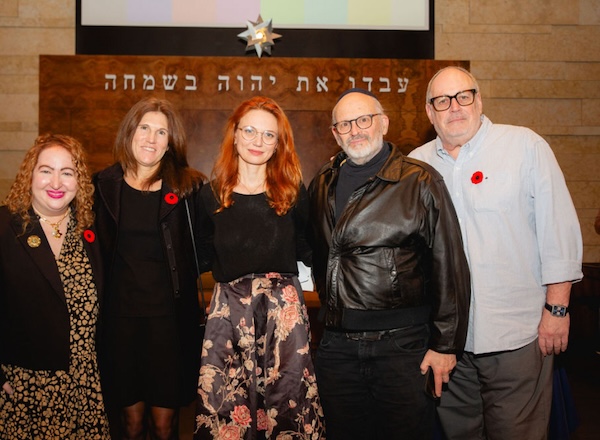
Left to right: Abby Wener Herlin, Lise Kirchner, Dr. Nataliia Ivchyk, Prof. Richard Menkis and Al Szajman at the community commemoration of Kristallnacht Nov. 7. (photo by Rhonda Dent)
The experiences of three Vancouver women who survived the Holocaust as children in Ukraine were highlighted at the community commemoration of Kristallnacht Nov. 7.
The event, which took place at and was co-presented by Congregation Beth Israel, marked both the 86th anniversary of the Kristallnacht pogrom and the 30th anniversary of the founding of the Vancouver Holocaust Education Centre (VHEC), which presents the annual commemoration. The Jewish Federation of Greater Vancouver and the Robert and Marilyn Krell Endowment at the VHEC were co-presenters.
The keynote address was by Dr. Nataliia Ivchyk, associate professor in the department of political science at Rivne State University for the Humanities, in Ukraine. Ivchyk is a visiting scholar at the University of British Columbia and has been studying the narratives of child survivors in the province.
About 1.5 million Ukrainian Jews were murdered in the Holocaust, while another million managed to flee before or near the beginning of the German-Soviet war, Ivchyk said.
“Genocide is ruthless, regardless of age or gender, and children are a special group of its victims,” she said. “Since children cannot fight back against their killers, they become a helpless and vulnerable group. The Holocaust claimed six million Jewish lives, 1.5 million of which were tragically children. Age became a vital marker of life or quick death for children during World War II and the Holocaust. Children were not seen as a separate group of victims, they were dependent on their parents, fathers, mothers and relatives, and so suffered and died with them too.”
Ivchyk quoted Malka Pischanitskaya, who was 10 years old when the Germans invaded her town of Romanov (now Romaniv), in Ukraine.
“I was brought into this world not by chance but I believe by destiny,” Pischanitskaya has said. “My destiny was to be born, to endure the sufferings that were yet to come.”
“During the genocide,” Ivchyk said, “Malka had no choice but to become an adult in order to survive.”
Another local survivor whose story Ivchyk told is Ilana, who asked that her last name not be shared. Ilana was born in 1938, just two years before Germany invaded the Soviet Union. Her father managed to evacuate the family, including Ilana, her sister, her mother and her maternal grandparents, to a Central Asian republic of the Soviet Union.
“Unfortunately, my father’s parents stayed in Kyiv and perished in Babyn Yar,” Ivchyk quoted Ilana, referring to the mass killing site that has become synonymous with the genocide in Ukraine. On Sept. 29 and 30, 1941, more than 33,000 Ukrainian Jews were killed, part of the genocide in eastern Europe known as the “Holocaust by bullets.”
Ilana has only fragmentary memories of the evacuation years. However, she remembered her sister, who cared for her, and her mother, who tirelessly worked to provide food, said Ivchyk.
A third local woman who survived is Esfira Golgheri.
“Esfira does not recall the journey from one ghetto to another, but she remembers her mother feeding her, which was crucial for her survival as an infant,” Ivchyk said.
“There is something that the Holocaust could not take away: memory, personal memories and stories of relatives and friends and our collective memory [that] remind us by honouring the memory of those who are no longer with us. Those who lost their lives and those who fought to defend us, we keep them alive in our hearts,” Ivchyk said. “The stories of these women are stories of childhood, family and survival in the face of genocide and displacement. Each narrative is unique and personal, yet the memories of Esfira, Malka and Ilana … are like pieces of a puzzle that help reconstruct this tragedy. In addition to piecing together the events of the war in Ukraine during the Holocaust, we have the chance to understand the tragedy through the eyes of these adult child survivors. We can touch their memories and experience their truth for ourselves.”
At the commemoration, Taleeb Noormohamed, member of Parliament for Vancouver Granville, brought greetings from the federal government.
“The fight against antisemitism is not one for Jews alone,” said Noormohamed. “Quite the opposite. It is a fight that all of us have to take on together.”
Nina Krieger, until recently the executive director of the VHEC and elected as member of the BC Legislature on Oct. 19, brought greetings from the provincial government.
“I know the premier of British Columbia and my colleagues in government join me in gratitude for the Vancouver Holocaust Education Centre and Congregation Beth Israel for presenting this evening’s program to mark the 86th anniversary of Kristallnacht,” Krieger said.
Vancouver Mayor Ken Sim, accompanied by Councilor Lenny Zhou, presented a proclamation from the city marking Kristallnacht Commemoration Day.
Sim spoke of how his home had been recently vandalized and how many people at that evening’s event had expressed sympathy.
“The Jewish community sees this all the time and I should really be asking you how you are doing,” he said. “I obviously loved the community before, but you’ve captured my heart even more.”
He said his presence at Jewish community events is not about politics.
“If everyone was against us, we would still have your back. We are still here because we stand for what’s right,” Sim said.
Lise Kirchner, director of education at the Vancouver Holocaust Education Center, spoke on behalf of acting executive director Hannah Marazzi, who was out of the province, read greetings from Prime Minister Justin Trudeau and acknowledged elected officials from all levels of government, including incoming and outgoing members of the BC Legislature.
“As we come together this evening to commemorate the 86th anniversary of the Kristallnacht pogrom, we contemplate the dangers not only of state-instituted persecution and violence, but maybe more importantly the dangers of indifference,” said Kirchner. “We are reminded of the consequences of antisemitism which is not publicly condemned, especially at a time when we have seen the proliferation of this most pervasive and pernicious form of hatred around the world, across the country and in our own backyards.”
Prof. Richard Menkis, associate professor of Jewish history at the University of British Columbia, contextualized Kristallnacht as a turning point between the legislated antisemitism of the Nazi regime, notably the Nuremberg Laws of 1935, and the murderous violence of the Holocaust.
“The persecutions during and immediately after Kristallnacht resulted in the deaths of at least 90 Jews, the destruction of hundreds of synagogues, the vandalization of thousands of Jewish businesses and the imprisonment of over 30,000 Jewish men in concentration camps and elsewhere,” said Menkis.
Al Szajman, president of the Vancouver Holocaust Centre Society board, emceed the evening. Abby Wener Herlin, associate director of programs and community relations at the VHEC and granddaughter of survivors, introduced Ivchyk. Rabbi Jonathan Infeld thanked Ivchyk and reflected on her remarks. Cantor Yaacov Orzech chanted El Moleh Rachamim. Holocaust survivors lit candles at the beginning of the commemorative event.
Ivchyk spoke movingly of being welcomed into the community during her time in Vancouver.
“Coming from a wartorn country myself, you accepted me, understood me, opened the doors of your community and your homes, creating an incredibly warm and family-like environment that gave me a home away from home,” she said. “You have entrusted me with your history and the history of your families and your childhood experiences that you have kept in silence for many years. Every time you shared your stories, I could feel the sadness and pain in your eyes. You still feel for those who were taken by the Holocaust.”