Skip to content
  • Home
  • Subscribe / donate
  • Events calendar
  • News
    • Local
    • National
    • Israel
    • World
    • עניין בחדשות
      A roundup of news in Canada and further afield, in Hebrew.
  • Opinion
    • From the JI
    • Op-Ed
  • Arts & Culture
    • Performing Arts
    • Music
    • Books
    • Visual Arts
    • TV & Film
  • Life
    • Celebrating the Holidays
    • Travel
    • The Daily Snooze
      Cartoons by Jacob Samuel
    • Mystery Photo
      Help the JI and JMABC fill in the gaps in our archives.
  • Community Links
    • Organizations, Etc.
    • Other News Sources & Blogs
    • Business Directory
  • FAQ
  • JI Chai Celebration
  • JI@88! video

Recent Posts

  • Eby touts government record
  • Keep lighting candles
  • Facing a complex situation
  • Unique interview show a hit
  • See Annie at Gateway
  • Explorations of light
  • Help with the legal aspects
  • Stories create impact
  • Different faiths gather
  • Advocating for girls’ rights
  • An oral song tradition
  • Genealogy tools and tips
  • Jew-hatred is centuries old
  • Aiding medical research
  • Connecting Jews to Judaism
  • Beacon of light in heart of city
  • Drag & Dreidel: A Queer Jewish Hanukkah Celebration
  • An emotional reunion
  • Post-tumble, lights still shine
  • Visit to cradle of Ashkenaz
  • Unique, memorable travels
  • Family memoir a work of art
  • A little holiday romance
  • The Maccabees, old and new
  • My Hanukkah miracle
  • After the rededication … a Hanukkah cartoon
  • Improving the holiday table
  • Vive la différence!
  • Fresh, healthy comfort foods
  • From the archives … Hanukkah
  • תגובתי לכתבה על ישראלים שרצו להגר לקנדה ולא קיבלו אותם עם שטיח אדום
  • Lessons in Mamdani’s win
  • West Van Story at the York
  • Words hold much power
  • Plenty of hopefulness
  • Lessons from past for today

Archives

Follow @JewishIndie
image - The CJN - Visit Us Banner - 300x600 - 101625

Tag: Claire Sicherman

A childhood spent on the run

A childhood spent on the run

Survivor Miriam Dattel, right, with the Vancouver Holocaust Education Centre’s Ellie Lawson at the Yom Hashoah commemoration April 23. (screenshot)

Miriam Dattel was born Branka Friedman, in September 1940, in the Croatian city of Zagreb, then part of Yugoslavia. She was about six months old when the Nazis invaded and her family began a life in hiding. Fleeing ahead of the Nazis and their collaborators, the family survived together through a series of close calls, lifesaving tips from compassionate officials, luck, determination and exhausting treks through the wilderness in search of refuge.

Dattel shared her family’s story at the annual Yom Hashoah commemoration at Temple Sholom on April 23.

Upon invading Yugoslavia in April 1941, the Nazis, aided by their Croatian fascist Ustaše collaborators, immediately instituted the Nuremberg Laws and set up the first concentration camps in Yugoslavia. Dattel’s father and uncle were thrown out of the university and all Jews were forced to don the yellow star – including on young Branka/Miriam’s baby carriage.

The family was set to flee to Budapest, where they believed they would find refuge with family. When the day came, the baby Branka was ill, so her grandmother, Irma Stern, was sent on ahead. It was the last time the family saw her. 

In her haste, the grandmother left behind her prayer book, which was her ubiquitous companion. Branka’s mother viewed the holy book as a fortuitous omen that all would be well in the end. At the commemoration last month, Dattel held the prayer book, now more than a century old and suffering the inevitable evidence of time. 

Eventually, the family fled – but not to Hungary. Branca/Miriam, her parents, Andor and Margita Friedman, and her aunt and uncle, Lili and Fritz, were transported with the help of a friend of her uncle’s southwest to the Croatian city of Split on the Adriatic coast. Sections of the city were controlled by the Italian fascists and others by the Croatian regime. 

One day, her father was tipped off by a high-ranking Italian officer that the Croatians were preparing to deport Jews from the areas of Split they controlled. He returned home in the middle of the night and evacuated the family to the Italian side. Eventually, the family’s race against fate continued, with a journey under false identities by ship to northern Italy.

“In 1943, when eventually Mussolini was finished, the Germans took over,” Dattel said in a video at the ceremony. Again, her father was tipped off by an Italian official, who warned him to disappear. 

“From then on, from what I saw in my father’s diary, we went through 18 different hiding places,” she said, noting assistance from underground operatives.

As a child forced to race from one place to another, few distinct memories remain. However, in various barns where they took refuge, people would roast chestnuts and that remains an evocative taste-memory for her.

Ovaltine is another. And it is a flavour from the very moment that may have saved the life of Miriam and her family.

The group – now six with the addition of her newborn cousin Gerardo – had made their way through northern Italy, around Lake Como and toward the Swiss border. After walking for hours, crossing under fences and trudging through difficult terrain, they came to the frontier of Switzerland.

“There were two Swiss border guards there,” said Dattel. “They said the border is closed. And my father said, impossible, you are not going to let two kids be killed. My recollection is this Swiss soldier [with] a German Shepherd coming towards me, lifting me up and carrying me to the station, to the border house.”

There, the guard gave her Ovaltine and, while she has tried to recreate the flavour, it has never tasted the same.

The family members were placed in refugee camps, Miriam separated from her parents. In Switzerland, the family lived out the war, returning to Zagreb afterward before Miriam and her parents made their way to Israel. 

About 1.5 million Jewish children were murdered in the Holocaust. Miriam was one of an estimated six to 11% who survived. In addition to the video screened at the event, Dattel spoke on stage with Ellie Lawson, the Vancouver Holocaust Education Centre’s education manager.

Claire Sicherman, a granddaughter of survivors, was the third-generation descendent speaker. She spoke of being consumed by grief in early life and growing up in a family filled with silences. (Sicherman shared her story of trauma and recovery earlier this year. See jewishindependent.ca/healing-trauma-possible.)

Hannah Marazzi, acting executive director of the VHEC, noted that this year marks the 82nd anniversary of the Warsaw Ghetto Uprising, a symbol of defiance in the face of annihilation. In addition to remembering the millions of lives lost and the resilience of survivors, she said, “We remember the young Jewish fighters who rose up against the Nazis and whose courage continues to inspire us to stand against oppression in all of its forms.”

Rabbi Carey Brown, associate rabbi of Temple Sholom, welcomed attendees to the synagogue and reflected on the past’s lessons for the present.

Dr. Abby Wener Herlin, associate director of programs and community relations for the VHEC and a member of the third generation, introduced survivors, who lit candles of remembrance.

Cantor Shani Cohen chanted El Moleh Rachamim, the memorial prayer for the martyrs.

Wendy Bross Stuart was responsible for musical direction and arrangement, and played piano. Eric Wilson played cello. Cantor Michael Zoosman, Erin Aberle-Palm, Matthew Mintsis and Lorenzo Tesler-Mabe sang.

As is traditional, the annual ceremony ended with the singing of “Zog Nit Keynmol,” “The Partisan Song.” 
Format ImagePosted on May 9, 2025May 8, 2025Author Pat JohnsonCategories LocalTags Claire Sicherman, history, Holocaust, Miriam Dattel, second generation, speakers, survivors, VHEC, Yom Hashoah
Healing trauma possible

Healing trauma possible

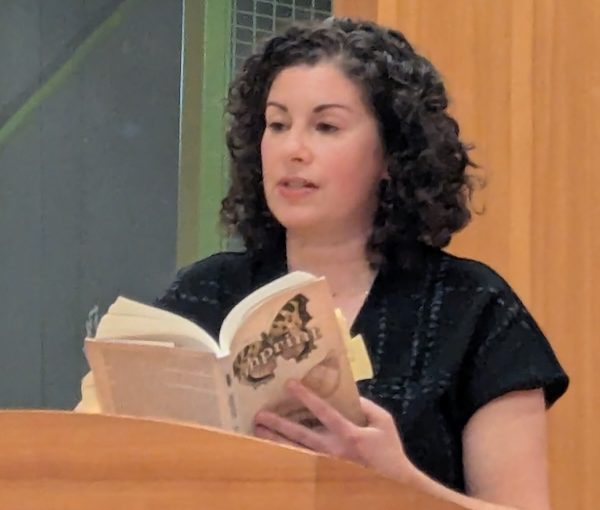
Claire Sicherman read from her book Imprint, about intergenerational trauma, at UBC Hillel on Jan. 21. (photo by Pat Johnson)

Understanding of intergenerational trauma has expanded in recent decades. Two granddaughters of Holocaust survivors discussed the larger phenomenon and their personal experiences recently at the University of British Columbia’s Hillel House, part of Hillel’s Holocaust Awareness Week. 

Claire Sicherman, author, workshop facilitator and trauma-informed somatic writing coach, shared her experiences and read from her book, Imprint: A Memoir of Trauma in the Third Generation, which was published in 2017. She was in conversation with Dr. Abby Wener Herlin, associate director of programs and community relations at the Vancouver Holocaust Education Centre, which co-sponsored the Jan. 21 event with Hillel BC.

Sicherman attributed to psychologist Dr. Arielle Schwartz the definition of intergenerational trauma as the ways in which the unresolved experiences of traumas, losses and griefs of one generation can become a legacy that is passed down to the next generation. 

“In other words,” said Sicherman, “the experiences of my grandparents are passed down through my parents to me.”

In addition to the “nurture” component of family legacies, there is the “nature” component of epigenetics, which Sicherman described as “the study of how genes turn on and off in response to environmental change.”

“I’ve heard it talked about like it’s sort of like light switches switching on and off in the body,” she explained. “Whatever switches switched on for my grandparents would then be switched on, passed down to my parent, passed down to me.” 

Experts in the field say it’s not a biological prison, Sicherman said. “They are actually malleable, so what you’re born with, you are not necessarily stuck with. We do have the ability to change certain things. There is hope in that.”

Growing up, Sicherman knew little or nothing about inherited trauma.

“When I started reading about it, I began to understand that what was going on with me wasn’t really my fault or that it wasn’t really something wrong with me,” she said. “It was just that I was carrying this huge thing.”

Reading excerpts from her book, Sicherman recounted being “disconnected from my body.” The inherited trauma manifested as a nervous system on overdrive and a tendency to hypervigilance. She was always ready to bolt out the door, looking for exit signs, aware of potential dangers, unable to fully rest, and prone to stress and anxiety.

She said that untold stories often pass more powerfully from generation to generation than stories that are recounted.

“When you think about that,” said Sicherman, “it’s what we don’t talk about that has more weight. It’s the silence. It’s the secrets.… That’s why it’s also important to me to speak out about these things, because it’s healing that goes across generations.”

Her survivor grandparents thought they were protecting their children through silence, Sicherman said. In response, the second generation learned not to ask questions.

There were other silences. In addition to the limited discussion around the Holocaust, Sicherman did not learn until well into her own adulthood that, when she was 4 years old, her grandfather had taken his own life, and not died of a heart attack, as she had been led to believe.

As someone who writes about and works with others on issues of healing intergenerational trauma, she urges people to embrace the totality of what they have inherited.

“Aside from trauma, what are the legacies that your ancestors bring to you?” she asked. “What are the gifts? What are the strengths? That’s also an important question to ask yourself, and a way of connecting with Jewish heritage. What are the strengths of your lineage? Is it survival? Is it tenacity? Is it humour? Is it creativity? Those are questions that you can ask yourself.”

Her son, Ben Sicherman, a UBC student, was present and also spoke of his family’s legacy of trauma. He described struggling with anxiety when he was younger and learning mechanisms for addressing issues through his parents’ modeling. He also spoke of carrying the legacy of his ancestors in ways like choosing 18 as his hockey number, not only because it represents chai, life, but because the numbers on his great-grandmother’s Auschwitz tattoo added up to the number 18.

Intergenerational trauma is a major component of her life’s work, said Sicherman.

“I do feel a sense of obligation, as a third generation,” she said. “But I also feel like this is part of my calling, too. It’s very meaningful. It’s an obligation that is not homework. It’s part of what I was set out to do.” 

Format ImagePosted on February 14, 2025February 13, 2025Author Pat JohnsonCategories LocalTags Claire Sicherman, health, Hillel House, Holocaust, Holocaust Awareness Week, Imprint, intergenerational trauma, mental health, second generation, survivors, third generation, trauma, VHEC
Coping with a legacy of loss

Coping with a legacy of loss

Claire Sicherman began writing Imprint: A Memoir of Trauma in the Third Generation after her grandmother passed away. (photo from VHEC)

Claire Sicherman’s grandmother didn’t share much about her experiences in the Holocaust. There were three stories – one about bread in Auschwitz, another about her tattoo, a third about washing – none of them overly traumatizing. It was in the silences, though, in what her grandmother did not share, that Sicherman sensed the deep trauma permeating her family.

“When I grew up, there was a constant heaviness that I couldn’t name,” Sicherman told the Independent. “I grew up knowing about the Holocaust but not really knowing too much about my family’s personal struggle with it, the stories.”

Her understanding of the Shoah came more from reading Anne Frank and watching Schindler’s List than hearing firsthand accounts from her grandmother.

These unspoken traumas, conveyed across generations, are what Sicherman will speak about at the High Holidays Cemetery Service, an annual commemoration presented by the Vancouver Holocaust Education Centre, Schara Tzedeck Congregation and Jewish War Veterans. The event takes place this year on Sept. 16, 11 a.m., at Schara Tzedeck Cemetery, in New Westminster. Her presentation is titled Honour and Remember: Breaking the Silence in the Third Generation.

Sicherman explored the topic in her book Imprint: A Memoir of Trauma in the Third Generation, which she began writing after her grandmother passed away. (See jewishindependent.ca/long-enduring-trauma.)

“After my grandmother died, it was safer to start uncovering the silences,” she said. “I think it’s much safer for the third generation to explore the stories of their families. For the second generation, especially for my mom, for example, there was this not wanting to hurt her parents.

“I experienced a bit of that when my grandmother was alive in that we just knew automatically not to ask certain questions, not to go there. For some of the second generation, the silence was a normal part of life. For others, the opposite is true. It was constantly talked about to the point that it became unhealthy that way. But, for my family, the silence was the norm. I think, in third generations, now you’re seeing more people wanting to talk about it, wanting to get back and explore the roots and figure out what they are carrying.”

Sicherman cites the relatively new science of epigenetics to suggest the weight of family history. As a response to that possibly inescapable legacy, Sicherman practises forms of yoga that release stresses in the body, journaling as a form of therapy and an Ayurvedic diet, which incorporates healthy foods and mindful eating rituals, all of which can potentially ameliorate the effects of inherited trauma.

Sicherman’s grandparents, who were from Prague, were the sole survivors in their respective families. They escaped communist Czechoslovakia in 1968 and settled in the Vancouver area. When Sicherman was 4 years old, her grandfather passed away. The cause of death, she was told, was a heart attack. In her 30s, Sicherman learned that her grandfather had committed suicide. This was another of the family’s secrets.

Despite the hidden past, Sicherman thought her family was entirely ordinary.

“For me, growing up, it was really normal,” she said. “I didn’t know that what my family went through, what I was carrying, what everyone was carrying and not talking about, was not quite normal. For me, I thought I came from a Leave it to Beaver kind of family.”

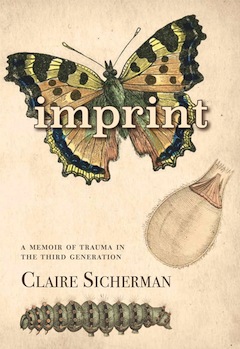
Sicherman’s dawning realizations of her family’s story and the weight of that history represent a sort of metamorphosis, she said. The cover of her book features a caterpillar, a cocoon and a butterfly.

“This sort of represents being third generation,” she said. “The symbolism around the butterfly is one of transformation and I feel, in writing this book, I was able to carry the story of my ancestors in a different way, and that’s where the transformation comes from.”

Format ImagePosted on August 31, 2018August 29, 2018Author Pat JohnsonCategories LocalTags Claire Sicherman, High Holidays, Holocaust Centre, Schara Tzedeck, VHEC
Long-enduring trauma

Long-enduring trauma

I approached Imprint: A Memoir of Trauma in the Third Generation (Caitlin Press, 2017) with reluctance. But Claire Sicherman’s account of her murdered family members, of her grandparents who were the sole survivors of the Holocaust and of her own intimate life as granddaughter, woman, wife and mother is profoundly moving and tender. Her accounts of her relatives’ lives and deaths under the Nazi regime are brutal and shocking. The proximity of these emotions makes the book challenging to read but hard to put down.

Sicherman’s choice of the title Imprint helped me understand just how stubborn and long-lasting the impression of anxiety, grief and horror can be to the human psyche. My mind went to the reality of fossils. According to one source online, sometimes an animal “is buried before it is destroyed. And when that happens and conditions are just right, the remains of the animal are preserved as fossils…. Fossils are the naturally preserved remains or traces of ancient life that lived in the geologic past…. Fossils represent the remains or traces of once-living organisms.”

For Sicherman, the emotions related to the destruction of her family are permanently imprinted in her body and in her genetic makeup. She must now bring them to conscious awareness.

The juxtaposition of cold, hard accounts of death – as in the chapter “My Family” at the beginning of the book – immediately followed by the first letter to her 9-year-old son Ben, signed “Love Always,” warns the reader that what follows is not for the faint-at-heart. She alternates between three essential narratives: the telling of the destruction and deaths of her relatives in Poland; the survival of her grandmother and grandfather, which leads to the intimate story of her mother and Sicherman’s youth; and the traumatic birth of her son Ben, which acts as a catalyst, breaking through lifelong barriers of ignorance, denial and grief.

book cover - ImprintIn gazing at the cover of the book, the three images of caterpillar, cocoon and butterfly began to make sense. This metamorphosis becomes the symbol of Sicherman’s lifecycle; the lack of awareness of her family’s history, the birth of her son, and her desperate search for knowledge and understanding of why she suffers from chronic health conditions, anxiety and depression.

Sicherman’s answer to the question “why” lies within the concept of epigenetics, the study of heritable changes in gene expression. Traumatic events cause changes in gene expression that can then be inherited. For Sicherman, her task is to explore, through various forms of therapy, the intergenerational transmission of trauma – the genetic imprinting of the horrors that befell her great-grandparents, her great-aunts and great-uncles and their progeny. Despite the distance of being a third-generation Holocaust survivor, her writing captures the beauty and intimacy of family affection (“My Babi,” “My Deda”). Hope of healing and surviving trauma permeate the pages of this creative book, offering acceptance and guidance to others of her – and the next – generation.

Dolores Luber, a retired psychotherapist and psychology teacher, is editor of Jewish Seniors Alliance’s Senior Line magazine and website (jsalliance.org). She blogs for yossilinks.com and writes movie reviews for the Isaac Waldman Jewish Public Library website.

Format ImagePosted on May 4, 2018May 2, 2018Author Dolores LuberCategories BooksTags Claire Sicherman, epigenetics, Holocaust, memoir, survivors, third generation
Proudly powered by WordPress